
History of Language
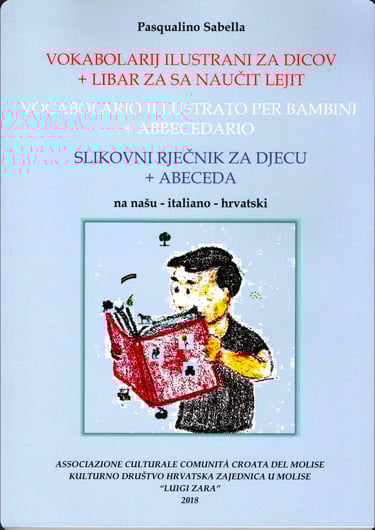
In the Molise region, there are five municipalities with a Croatian linguistic minority: Acquaviva Collecroce, Montemitro, and San Felice del Molise, the three communities where the language is still spoken, joined more recently by Palata and Tavenna. The language is officially called “Croatian Molisan,” but in recent years some scholars have used the terms “Slavic Molisan,” “Slavisano,” and “Molislavic.” Croatian Molisan is a minority language that has Italian as its dominant contact language. It was officially recognized with the ratification of the Treaty between the Italian Republic and the Republic of Croatia on the rights of minorities, signed on November 5, 1996, in Zagreb and implemented in Italy with Law No. 482 of 1999, “Protection and Enhancement of Historical Linguistic Minorities.” The Treaty guarantees minorities the freedom to use their mother tongue in public and in private, in official municipal documents and in registry certificates, to establish cultural associations, and to express their identity. Speakers of minority communities call their language “naš jezik” (“our language”) or, with an adverbial expression, na našu o na našo (“to ours”). Despite numerous literary attempts since the 19th century, our language remains today a purely spoken language with no written form. To date, a great deal has been written about the Croatians of Molise: travelogues, historical reviews, ethnographic works, sociological research, linguistic discussions, sociolinguistic works, and much more.
The Croatian communities of Molise and language
Linguistic studies and origins
The best documented and most comprehensive study of the Croatian dialect spoken in Molise is that of Milan Rešetar, written at the beginning of the 20th century. After extensive research and a prolonged stay in the region, Rešetar concluded that the dialect spoken by Croatians in Molise can be linked to the Croatian dialects of the 15th and 16th centuries, which were widespread in the Biokovo-Neretva area.
Preservation and transformation of linguistic heritage
Therefore, in the absence of historical evidence, this is our most important document on the ancestral homeland of the Croatians of Molise and the moment of their arrival. The Croatian dialect of Molise is a “specific” case of preservation of cultural identity. In some ways, it has managed to preserve itself for almost five centuries, and only through oral tradition. Today, we could therefore also refer to it as a “language in cold storage.” Of course, the Croatian language of Molise has undergone and continues to undergo its own evolution and involution, but it has preserved its vocabulary (about 3,000 words), which allows for a sort of lower-level colloquial process. Most of the words related to agriculture, the home, plants and animals, the human body and its functions have been preserved in our language. As far as the preservation of linguistic heritage is concerned, it is more the result of a defensive reaction to external influence than of cultural backwardness and isolation. Unfortunately, today this linguistic heritage is shrinking dramatically, because the terms refer to objects that are no longer in use, while modern objects have Italian names.
Publications
Walter Breu
Walter Breu
Milan Reöetar
▶︎ •၊၊||၊|။||||။ ၊|•
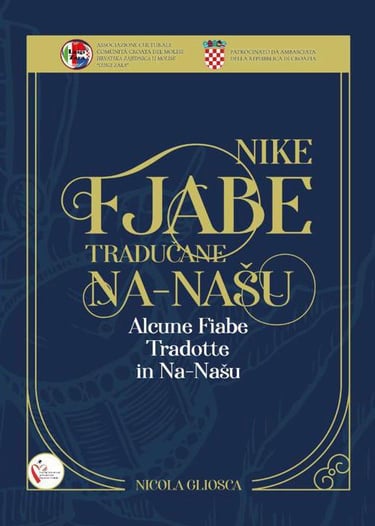
Nicola Gliosca - Nike Fjabe tradučane na-našu - Audio by Pasqualino Sabella
▶︎ •၊၊||၊|။||||။ ၊|•
Nicola Gliosca - Reading and Translation of the Gospel of Mark
▶︎ •၊၊||၊|။||||။ ၊|•
▶︎ •၊၊||၊|။||||။ ၊|•
Nicola Gliosca - Sep aš Mena - Kapituj - Performed by Rino John Gliosca
Articles
Books
Audios
Associazione Culturale Comunità Croata del Molise “Luigi Zara”
ass.croataluigizara@gmail.com
+39 0874 874520
C.F. 92048440702